
A poor monsoon could drag overall economic growth and compound the impact of the West Asia conflict on the Indian economy.

'Narendra Modi -- a man with deep and vital experience of Indian politics -- has seen the BJP lose many elections between 1975 and 2015, and with every defeat, he learned lessons that made sure he would never allow his party to be defeated so easily again.'

India will now face a lower reciprocal tariff of 10 per cent, down from 25 per cent, after US President Donald Trump announced a new global levy on items imported into America in the wake of the Supreme Court verdict against his sweeping duties on several nations.

An Indian AI Research Organisation official says India has adopted a balanced and pragmatic approach to AI regulation, avoiding the extremes of the US and EU models.
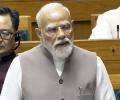
Prime Minister Narendra Modi addressed Parliament on the West Asia crisis, advocating for dialogue and diplomacy, ensuring the safety of Indians in the region, and addressing concerns about fuel and food security.

Trinamool Congress leader Abhishek Banerjee has urged voters to support the TMC as the only way to defeat the BJP, particularly in areas with a strong Congress base. He accused the BJP of dividing communities and failing to address key issues such as river erosion and farmer distress, while outlining the TMC's welfare plans.

Iran was the chance to arrange a concert of nations, to actually be a Vishwaguru. Instead, we are watching from the sidelines as Pakistan, the same country that is apparently still at war with Afghanistan, hosts talks between US-Israel and Iran. The irony is hard to miss, points out Amberish K Diwanji.
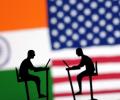
The US said India will lower tariffs on a "vast array" of American industrial and agricultural goods, such as "fruits, vegetables", to zero per cent under the trade deal announced by President Donald Trump.

Modi also said that President Trump's leadership is vital for global peace, stability, and prosperity.

The cost of the war is being counted not in the corridors of power in Washington or Tehran, but in Firozabad's darkened furnace rooms, Howrah's idle casting sheds, and a barbershop in Kochi where the wait is suddenly, inexplicably, an hour long, notes Prem Panicker in his must read blog on the Iran War.

Congress leader Rahul Gandhi has accused Assam Chief Minister Himanta Biswa Sarma of corruption and land grabbing, promising action if the Congress party wins the upcoming elections in Assam. Gandhi also criticised the BJP's governance and economic policies.

Both sides have now revealed a preference for escalation over strategic defeat, and each new provocation narrows the space for the next pause. The Touska seizure, Iran's refusal to negotiate under blockade, Israel's strikes on Iranian oil infrastructure -- all of these add up to an increasingly untenable situation. This makes the wild card -- Trump and his motormouth -- more consequential than ever, notes Prem Panicker in his must read blog on the Iran War.

The government has sharply reduced excise duty on petrol to 3 and diesel to zero, offering major relief to consumers. Here's how the price cut will impact fuel rates and inflation.

Prime Minister Narendra Modi will visit Israel to enhance defence and trade cooperation amid Middle East tensions. Discussions will include defence, security, and the situation in Gaza.
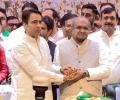
Former JD(U) leader KC Tyagi has joined the Rashtriya Lok Dal (RLD), citing shared ideologies with Chaudhary Charan Singh and Ram Manohar Lohia. He aims to strengthen the party and champion the cause of farmers.

'In the last one year, we have added more than Rs 1.7 trillion, and we are on track.'

Prime Minister Narendra Modi held a virtual meeting with chief ministers to review preparedness and plans in light of the West Asia conflict, emphasising the importance of national unity and enhanced security measures.

Indian rice exporters are seeking urgent government support to mitigate the impact of shipping disruptions caused by the Iran crisis and instability in key maritime routes. The disruptions have led to increased freight rates, insurance premiums, and fuel costs, impacting domestic prices and exporter profitability.

'Oil is still well below its all-time highs, and the world is gradually running out of known reserves.'

AICC President Mallikarjun Kharge criticised Prime Minister Narendra Modi's relationship with US President Donald Trump, alleging that Modi is acting as Trump's 'slave' and jeopardising India's interests on trade, oil and foreign policy.

A special PMLA court in Ahmedabad rejected the bail plea of IAS officer Rajendrakumar Patel, arrested by the Enforcement Directorate in a bribery-linked money laundering case. The court cited evidence suggesting Patel's involvement in money laundering and the receipt of substantial bribe money.

India is emerging as Claude.ai's second-largest user base, driven by strong adoption in coding, maths and enterprise AI tasks.

In which area of Indian life are women not running the show?

Prime Minister Narendra Modi's visit to Israel aims to strengthen the strategic partnership between the two nations, focusing on cooperation in various sectors including defense, technology, and trade.

Congress leader Rahul Gandhi on Tuesday alleged that Prime Minister Narendra Modi buckled under United States pressure to finalise a trade deal and 'sold off' the hard work of Indian farmers through the agreement.

The question is no longer whether the war will expand. It has. The next few days will tell us whether the war stabilises around Hormuz or whether the Strait itself becomes the trigger for a far larger rupture. What to watch for over the next 48 hours is simple: Any move by the US toward direct naval control of the Strait; any credible Iranian attempt to disrupt or mine shipping lanes and, critically, whether energy infrastructure in the Gulf continues to be targeted.If those lines are crossed in tandem, the war will no longer be containable within the region.

New Delhi will substantially reduce tariffs on industrial and agricultural goods while continuing to protect sensitive sectors. Tariffs on some agricultural products that are not traditionally considered sensitive will be brought down to zero, while in the case of relatively sensitive items, duties will be reduced in a graded manner and quotas will be imposed.

'The contours of the trade deal need to be reworked now.'
'We are profoundly energy-dependent on the Gulf. That dependency must now be redirected towards the United States, because we require American permission to procure oil.' 'We additionally require Iranian permission to acquire oil from that source. So India now has to seek two separate permissions merely to secure its energy supply.' 'Should we be compelled to source from America, or from Venezuela -- which is, in effect, American-controlled supply -- that will inevitably carry a price premium, an elevated shipping cost, and a considerably extended delivery timeline, given the distances involved.'

'No one can wipe-off our glorious collaboration in The Kerala Story and Bastar, from Indian cinema.' 'When we create history and are scrutiniSed in public, we must be extremely responsible in our behaviour and conduct.'

New Zealand has taken a binding commitment under its Free Trade Agreement (FTA) with India to amend its laws within 18 months of the pact's implementation to facilitate the geographical indication (GI) registration of Indian goods besides wines, and spirits in the island nation. The current GI law of New Zealand only allows India's wines and spirits to be registered.
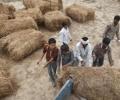
The agrarian crisis must be met with similarly speedy responses.

The United States, which entered this war in expectation of a short, sharp win along the Venezuela model, is now preparing for deeper involvement in a conflict it does not fully control, without the allies it typically relies on, against an adversary that is not behaving as expected, in a global environment that is already absorbing economic shock. Prem Panicker continues his must read daily blog on the Gulf War.
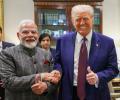
Trump announced that India and the US agreed to a trade deal under which Washington will charge a reduced reciprocal tariff on Delhi, lowering it from 25 per cent to 18 per cent.

India has clarified its position on the proposed interim trade agreement with the US, stating that the joint statement remains the basis for mutual understanding. Amendments to a White House fact sheet reflect shared understandings, with both sides working towards finalizing the agreement.

The turning point came with the appointment of Sergio Gor as the US ambassador to India.

India and Israel have elevated their relationship to a special strategic partnership, focusing on enhanced cooperation in trade, technology, and defense, while also addressing regional peace initiatives.
The agreement addresses non-tariff barriers and promotes increased trade in technology products and cooperation between the two countries.

Commerce and Industry Minister Piyush Goyal announced that an interim trade agreement between India and the US is likely to be signed in March and operationalised in April, with chief negotiators meeting in Washington to finalize the details.

India's economy experienced a growth of 7.8 per cent during the October-December quarter of 2025-26, according to the new series of national accounts with 2022-23 as the base year.
